
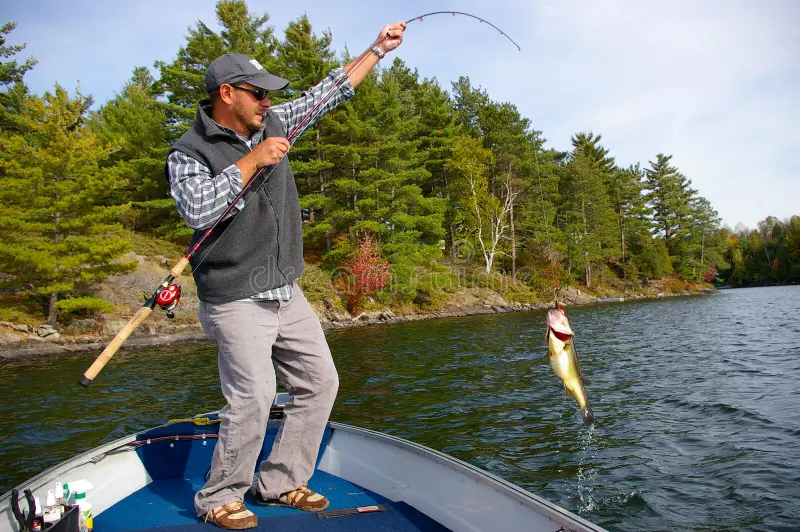
Welcome to our collection of posts on an introduction to angling!
This collection discusses the meaning of the word “angling,” describes a very basic fishing tackle setup, which can be used with live bait or artificial lures, and describes some special types of angling, such as fishing from a boat and ice fishing. It also introduces general fish behavior and explores the habits of some of the most popular species favored by anglers.
Though these posts are very basic, a quick perusal may yield some new and interesting bits of information, even for experienced anglers.
Fishing is one of humanity’s oldest food-gathering practices. At its broadest, fishing refers to any method of catching fish or other aquatic animals. This can include netting, trapping, spearing, hand gathering, and even modern industrial techniques using massive vessels and sophisticated electronics. Within this broad category lies a more specific and culturally rich practice known as angling. While the two terms are often used interchangeably in casual conversation, they describe activities that differ in purpose, technique, and complexity.
Angling is a particular form of fishing that relies on a hook attached to a line, which is manipulated by the angler to entice a fish to bite. The word “angling” itself comes from the Latin angulus, meaning “hook,” and that focus on the hook is central. Unlike net fishing or trapping, angling typically targets individual fish rather than large numbers at once. It emphasizes skill, patience, and an understanding of fish behavior, water conditions, and equipment. For many practitioners, angling is not merely a way to obtain food but a recreational, sporting, or even contemplative pursuit.
This distinction highlights one of the key differences between fishing and angling: intent and engagement. Fishing, in the general sense, can be purely utilitarian. Its goal may be efficiency and yield, with minimal concern for the experience of the fisher beyond success. Angling, by contrast, usually involves a direct, active relationship between the angler and the fish. The angler chooses specific tackle, presents bait or lures in deliberate ways, and responds to subtle signals transmitted through the line. Catching a fish is often only part of the reward; the process itself is central to the practice.
Angling is also notably complex. Beneath its seemingly simple image—a person holding a rod beside a body of water—lies a vast body of knowledge. Anglers consider factors such as water temperature, depth, clarity, current, weather, seasonal fish movements, and feeding habits. There are countless specialized techniques: fly fishing, spin fishing, bait fishing, float fishing, bottom fishing, and more. Each has its own equipment, terminology, and traditions. Even the choice of hook size or line thickness can make the difference between success and failure.
Because of this complexity, the term angling covers an enormous range of topics. It can encompass biology, hydrology, meteorology, craftsmanship, ethics, and environmental conservation. Discussions might range from knot-tying and rod action to fish physiology and habitat preservation. As a result, any serious attempt to explain angling must narrow its focus drastically. Without such narrowing, the subject becomes unmanageable. Introductory treatments often concentrate on the most basic equipment and techniques, providing a foundation upon which more specialized knowledge can later be built.
Here, we will limit our discussion to freshwater angling, recognizing that we are excluding a vast world of saltwater angling worthy of its own collection of posts.
At its most fundamental level, angling can be practiced with a very simple tackle setup. The core components are a fishing line, a hook, a weight, a float, and a rod or pole. Despite their simplicity, each part has a specific role.
At the lower end of the line is a lead weight known as a sinker. The sinker helps the line sink into the water and stabilizes the bait against currents or wind. Some distance above the sinker, a loop is tied in the line. This loop allows a fishhook to be easily attached and removed. The hook is attached by folding a section of the loop and threading the resulting loop through the eye of the hook. This forms a new loop, and passing the hook back through this new loop attaches the hook to the line. The hook can be easily removed by reversing these steps.
The hook is the critical element of angling, as it holds the bait and, when a fish bites, allows the angler to secure the catch.
Above the hook, attached to the line, is a fishing float, commonly called a bobber. The bobber is easily movable along the line, allowing the angler to adjust the depth at which the bait is presented. Floating on the water’s surface, it serves as a visual indicator: when a fish takes the bait, the bobber may dip, tilt, or disappear beneath the water, signaling a bite.
Finally, the line is attached to a stick or rod known as a fishing pole. This pole allows the angler to cast the line into the water, control its position, and respond when a fish bites. Even in its most basic form, the fishing pole provides leverage and sensitivity, and translates movements beneath the water into tactile and visual feedback for the angler.
Together, these simple components form the foundation of angling. From this humble setup grows a remarkably deep and varied practice—one that illustrates how angling, while a subset of fishing, stands apart as a skillful, nuanced, and richly layered human activity.