
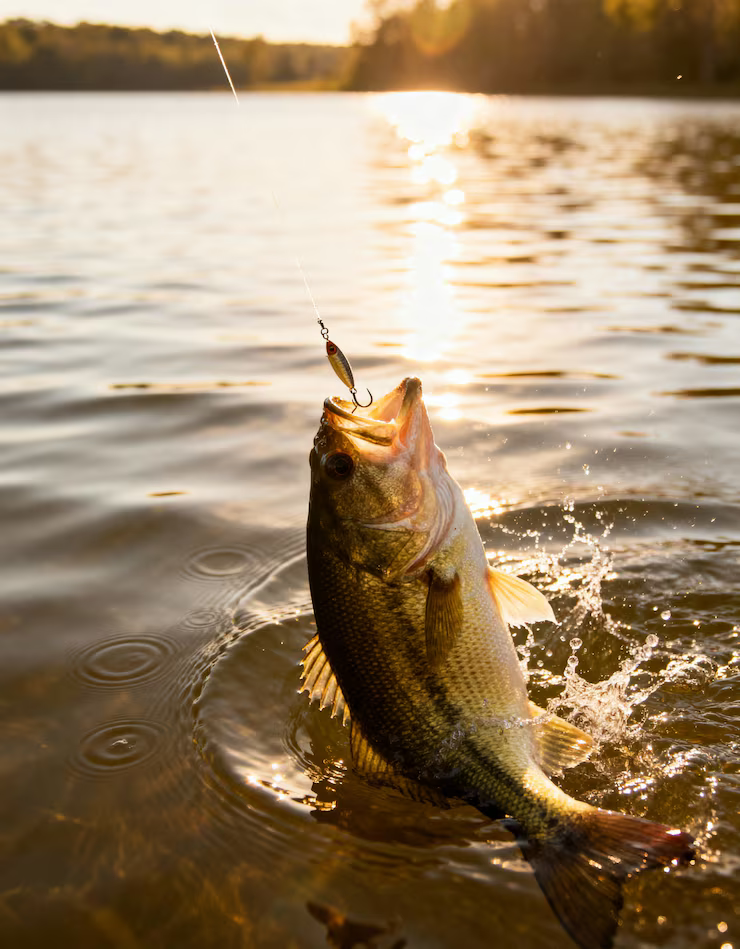
Fishhooks are among the oldest and most essential tools in angling, the practice of catching fish with a hook and line. The word angling itself comes from the Latin angulus, meaning hook, underscoring how central the fishhook is to this method of fishing.
In angling, fish are caught when they bite onto a real or artificial bait that has an embedded or attached hook. The hook penetrates the fish’s mouth—usually the lip or jaw—allowing the angler to control and eventually land the fish. Hooks are used with natural baits such as worms, insects, or fish, as well as artificial lures designed to imitate prey.
Fishhooks are sized and specified using a somewhat counterintuitive system. Hook sizes are specified by a system in which larger size numbers are associated with smaller hooks. For example, a size 32 hook is much smaller than a size 1 hook. For sizes larger than “1,” the sizing switches to “aught” measurements (written as 1/0, 2/0, up to 20/0 or larger) where size “2/0” is greater than size “1/0,” and so forth.
Fortunately, this last paragraph is for information only. Very few people will go into a store and ask for a size 11 hook. What is actually done is to go to a sporting goods store, look over the available hooks and try to choose one which will “fit” the fish we intend to catch. Usually we will want the hook to be about the same size as the mouth of the fish we are trying to catch.
One of the most common distinctions among fishhooks is between single and treble hooks. A single hook has one point and one shank, making it versatile and widely used for bait fishing, fly fishing, and many artificial lures. Single hooks are easier to remove from a fish’s mouth and are often preferred for catch-and-release fishing. Treble hooks consist of three single hooks joined at a central shank, forming three points. They are commonly used on hard-bodied lures such as crankbaits and spoons, where multiple points increase the chance of hooking a striking fish. However, treble hooks can cause more injury to fish and are more prone to snagging vegetation or debris.
Another important distinction is between barbed and barbless hooks. Most hooks are barbed. These feature a small backward-facing projection near the point, designed to prevent the hook from slipping out once it has penetrated. These hooks increase landing success but can make hook removal more difficult and potentially more harmful to fish. Barbless hooks, by contrast, lack this projection. They are easier to remove, reduce handling time, and are often required by fishing regulations in catch-and-release waters. Many anglers also crimp the barbs on standard hooks to achieve similar benefits.
Weedless hooks are designed to minimize snagging on aquatic plants, rocks, or submerged wood. They typically incorporate a wire guard or a hook orientation that shields the point until a fish bites down. Weedless designs are especially useful in heavy cover, such as lily pads or grassy shallows, where conventional hooks would frequently snag.
In sum, the different types of modern fishhooks, though simple, have been shaped by centuries of refinement. These variations and specialized designs are made to fit diverse conditions and goals of angling.
Fortunately, a deep knowledge of fishhook design and application are not required to choose a hook and begin fishing. It is possible to get started just by using common sense, and by knowing the common types of hooks available. Don’t obsess. You can’t go far wrong. Just go ahead and have fun!